Introduction — Why does room flow matter?
A classroom that moves well helps children feel safe, calm, and ready to learn. Good room flow lowers the chance they will run, bump into each other, or get upset. Small design choices and clear routines make a big difference. For ideas on calm classro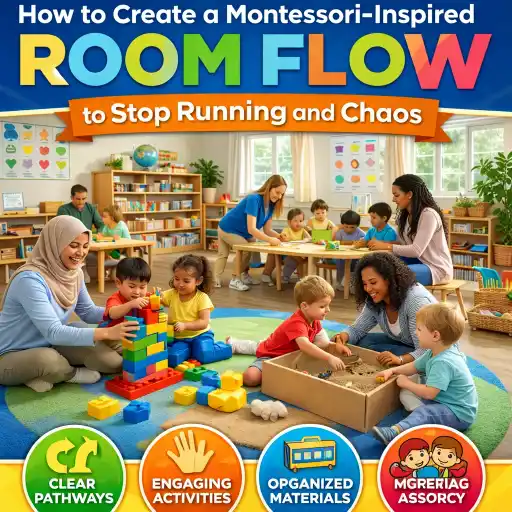 oms and why layout matters, see Creating a Positive and Calm Classroom Environment and Designing Learning Spaces that Inspire Curiosity, Not Chaos.
Why it matters:
- Children who know where to go are less likely to run. #Montessori
- Clear spaces help staff supervise and prevent accidents. #flow
Note: state requirements vary - check your state licensing agency.
1) How should I arrange shelves, rugs, and trays so that children move calmly?
Arrange items so they show children what to do. Low shelves with one activity per tray make choices easy. Trays and materials should be at children’s height and grouped by area (Practical Life, Sensorial, Language, Math). This helps children find work and return it correctly, which reduces traffic jams and chasing.
Practical steps:
- 🪵 Put shelves at child height and leave space between works.
- 📚 Use trays: one activity per tray so pieces stay together.
- 🧺 Store rugs in one spot and teach rug rules so rugs don’t become tug-of-war items.
These tips come from Montessori shelf and rug basics at Shelves, Rugs, and Trays: Montessori Layout Basics and Montessori classroom ideas for child care at Montessori Classroom Ideas for Child Care Providers. Keep materials limited and rotate often—less is more for focus. #shelves
2) What traffic patterns and furniture layout keep children from running?
Design paths that lead children naturally: a clear walking loop around centers and open sight-lines for adults let children move without bumping. Place high-interest shelves away from narrow corners and keep tables grouped to make natural “streets” for walking.
Try this plan:
- 🧭 Map one main loop so children can walk around the room without cutting through work areas.
- 📏 Keep walking lanes at least a child-width wide and remove long runways (open long hallways invite running).
- 🪑 Use low furniture to keep sight-lines clear for supervision.
For design tips and checklists that help reduce chaos, see Designing Learning Spaces that Inspire Curiosity, Not Chaos. Also consider seating that creates small group islands so children stop and work rather than run between distant spots. #transitions
3) Which routines, signals, and transition scripts actually work in group care?
Routines are the heart of calm flow. Use short, simple signals: a bell, a song, or a hand sign. Teach a few clear steps repeatedly (signal → 1–3 short actions → move). Calling small groups reduces crowding and long waits.
Steps to teach:
- 🎵 Pick one consistent signal for every transition (bell or short song).
- 🗂️ Teach the 3-part transition: Signal → Steps (short) → Go.
- 👣 Send small groups (first 4, then 4) to avoid long lines and running.
Research and practical guides about Montessori transitions and visual schedules help: see Montessori Transitions That Actually Work in Group Care and our guide on How to Create and Implement a Visual Schedule. Visuals reduce talking and help children know what comes next. #routines
4) How do I teach and coach staff and children — and avoid common mistakes?
Teaching is practice. Rehearse routines with staff and children, use short role-play, and give children helper jobs for set-up and reset. Observation shows what needs changing: watch where children bump into each other, where they wait, and where materials disappear.
Common mistakes and fixes:
- 🚫 Mistake: Too many choices out at once. Fix: Put out fewer works and rotate.
- 🚫 Mistake: Changing routines often. Fix: Pick a routine and practice it daily.
- 🚫 Mistake: Using “shush” or loud corrections. Fix: Use gentle signals and model calm behavior (see alternatives in Encouraging Quiet in the Montessori Environment).
Train staff with short, focused coaching: walk the room together, rehearse arrival, clean-up, and line-up scripts, and use a simple end-of-day reset that children can help with. For tested classroom strategies and checklists, see Classroom-tested strategies to help preschool teachers manage their classrooms. Regular observation and small fixes keep improvements real and lasting.
Conclusion — Quick checklist to try this week
Try these 5 steps and watch flow improve:
- 🪴 Move shelves to child height and limit works per shelf.
- 🧸 Teach one rug and tray routine and practice it three times this week.
- 🛣️ Create one main walking loop and remove at least one obstacle.
- 🔔 Pick one transition signal and rehearse it every day.
- ✅ Give children helper jobs for reset and praise their work.
These small, consistent changes help turn running and chaos into calm, independent movement. For more how-to ideas and printable tools, explore the linked ChildCareEd articles above and share them with your team.
-
For layout and flow (shelves, rugs, trays, clear pathways, and “less is more”), add The Prepared Environment: Montessori Class Design
 Buy Now $16.00—it’s all about designing an accessible Montessori environment that supports independence and smooth movement. (montessori4teachers.com Buy Now $16.00)
 -
For supervision + independence (so children can move freely without running, bumping, or chaos), include Mindful Supervision: Balancing Safety & Independence in Montessori
Buy Now $24.00—it focuses on active supervision strategies that fit Montessori “freedom within limits.” (montessori4teachers.com Buy Now $24.00)
FAQ
- How long before changes show results? Many classrooms see small improvements in 1–2 weeks if routines are practiced daily.
- What if a child still runs? Offer a clear job, a visual schedule, or a short sensory break. Observe triggers and adjust the environment.
- Can mixed-age rooms use these ideas? Yes — limit materials by level, and let older children model flow for younger ones.
- Do I need special Montessori materials? No. Child-height shelves, trays, and clear routines are more important than expensive materials.
- The Importance of Hands-On Learning in Montessori Education
- Montessori Education: Encouraging Independence and Self-Discipline
- Elementary Montessori: Fostering Curiosity & Responsibility
- Shelves, Rugs, and Trays: Montessori Layout Basics for Busy Classrooms
- How can a Montessori-inspired room flow stop running and chaos?
