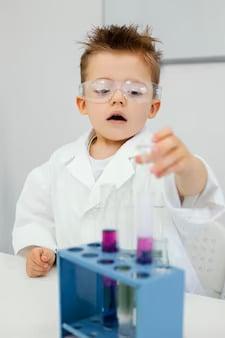
 There’s something wonderfully unpredictable about doing “science” with #preschoolers. One minute they’re observing a leaf with total focus — the next, they’re wearing it as a hat. But that’s the magic of it, isn’t it? Science, at its core, is curiosity — and if anyone embodies pure curiosity, it’s a three-year-old.
The best scientists in your #classroom may be covered in finger paint, but they’re testing hypotheses every day: What happens if I pour this? Touch that? Mix these together? The trick is learning to see their #play as the meaningful scientific exploration it really is.
🌱 Little Hands, Big Curiosity
When you think about #early science, don’t picture lab coats and test tubes — think mud pies, magnets, and magnifying glasses. Children are natural experimenters. They question, test, and retest constantly.
Our job as Montessori #educators is not to lecture about “science facts,” but to create environments that encourage observation, discovery, and wonder.
That’s exactly what the Building Early Science Foundations  Buy Now $16.00 course explores. It dives into how infants and #toddlers #develop cognitive skills that fuel curiosity, and how #teachers can transform everyday moments into scientific investigations. Through play-based learning, children begin to make sense of the world long before they ever read a textbook.
🧪 When Your Lab Partner Is Three
It’s not always easy to think like a scientist when your lab partner is more interested in tasting the experiment. But that’s part of the process — exploration happens through the senses.
When a toddler drops a block in a puddle, they’re learning about cause and effect. When they mix sand and water, they’re studying texture and transformation. When they line up objects or sort shells by size, they’re discovering patterns — the earliest steps toward classification and reasoning.
The challenge (and joy!) for teachers is learning to guide these discoveries without interrupting them. The secret? Ask, don’t answer.
-
“What do you notice?”
-
“What changed?”
-
“What do you think will happen next?”
That’s how you model scientific thinking — curiosity, patience, and reflection.
🌿 A Tray Full of Discovery
If you’re looking for a fun way to spark scientific thinking, try the Tiny Scientists Nature Investigation Tray.
It’s simple, #sensory, and incredibly effective. Fill it with natural materials — leaves, bark, seeds, pebbles, feathers — and watch the children explore. You can invite them to sort by color, texture, or size, or let them #freely handle the items to see what interests them.
This kind of hands-on exploration does more than keep little hands busy. It strengthens observation, fine motor skills, and vocabulary — all while nurturing curiosity. It’s the perfect blend of Montessori philosophy and early science inquiry.
🔬 What the Brain Knows (Even Before They Do)
If you’ve ever wondered why Montessori and science blend so beautifully, it helps to look at what’s happening in the brain.
In the article How Does Neuroscience Support Montessori Learning?, Montessori4Teachers explains how the child’s brain is wired to seek patterns and make predictions — in other words, to do science. When a child experiments and discovers something on their own, their brain releases dopamine, reinforcing learning and motivation.
This is why the Montessori approach — hands-on, self-paced, and rooted in exploration — naturally supports scientific #development. The more children investigate, the more confident they become in their ability to ask questions and find answers.
💡 From Curiosity to Confidence
When we create #classrooms that value curiosity over correction, children begin to see themselves as capable learners. They learn that mistakes are part of discovery — that “oops” moments are often the start of “aha” moments.
Here are a few easy ways to #nurture that mindset:
-
Celebrate questions — Treat a child’s “why?” as the start of a journey, not an interruption.
-
Model curiosity — Let children see you wonder aloud. “I’m not sure! Let’s find out together.”
-
Keep materials accessible — Freedom of choice fuels focus. Let them return to a favorite work or explore something new.
-
Document discoveries — Encourage children to share what they noticed. A drawing or simple retelling reinforces observation and memory.
When a classroom runs on curiosity, every child becomes a scientist — and every day becomes an experiment in discovery, cooperation, and joy.
🧭 Final Thought
You don’t need goggles or lab coats to teach science. You need curiosity, patience, and an openness to messy, beautiful exploration.
The next time a three-year-old proudly shows you a “discovery” — a leaf floating on water, a block tower that fell just right — pause, smile, and ask a question. In that small moment, you’re nurturing the roots of scientific thinking and lifelong learning.
So yes — think like a scientist. Even if your lab partner is three.
👉 Dive deeper into how early cognitive #growth builds scientific understanding with the Building Early Science Foundations Course Buy Now $16.00.
Pair it with the Tiny Scientists Nature Investigation Tray for real classroom fun, and explore how Neuroscience Supports Montessori Learning to understand the brain-based beauty behind your #students’ curiosity.
Stay Connected 📲
For more articles, resources, and training opportunities on #early-childhood-education, follow ChildCareEd on social media:
👉 Facebook
