Introduction
Montessori in child care is a way to set up the classroom, the teacher role, and the daily routine so children can learn by doing. In this article you will learn clear, practical answers that help directors and providers decide what Montessori looks like in a child care setting.
Why it matters: Montessori ideas can help children build focus, confidence, and real skills. A recent large study found public Montessori preschools improved reading, memory, and self-control while costing less in some settings — useful data for program planners (national study).
This article uses simple steps and short lists so teams can act on Montessori ideas right away. You will also see links to practical ChildCareEd resources so you can follow up quickly.
Key words: Montessori #classroom, #children, #independence, #preparedenvironment, #learning are used below to help direct you to topics.
1) What is Montessori in child care?
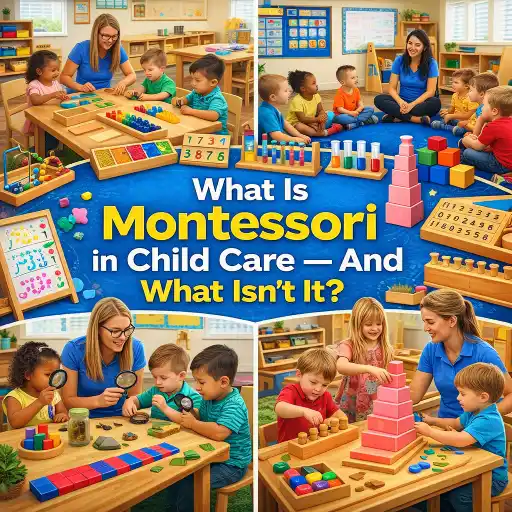
Montessori in child care means three main things work together:
- Prepared space: low shelves, clear trays, child-sized tools so children can choose and return work. See tips in Montessori Classroom Ideas for Child Care Providers.
- Teacher as guide: adults observe, introduce materials when children are ready, and step back so kids practice. ChildCareEd explains this role in The Montessori Guide.
- Hands-on materials and mixed ages: children use real objects and learn from peers. The prepared environment idea is described in Creating the Montessori Prepared Environment.
Practical points for child care providers:
- 🔹 Keep only a few clean, complete works out at once.
- ✅ Use natural materials where possible (wood, metal, cloth).
- 🌱 Group three ages together when you can — younger kids learn from older ones.
Montessori is flexible. You can borrow Montessori ideas (a \"Montessori-inspired\" classroom) without becoming a full Montessori school. For training and short courses, ChildCareEd offers courses like Montessori Assistant Training  Buy Now $250.00 and The Prepared Environment Buy Now $16.00.
2) How does a Montessori classroom look and feel in child care?
Think calm, ordered, and inviting. A Montessori #classroom usually divides into areas: Practical Life, Sensorial, Language, Math, and Culture. Each area has 2–4 simple shelves with one clear activity per tray (classroom design).
Practical setup checklist:
- 🧰 Child-sized furniture and reachable shelves.
- 📚 Trays and baskets with only the items needed for that work.
- 🧹 Open walking paths and a few rugs used as work spaces.
- 🌿 Natural items and a small nature or culture shelf for exploration.
Why this matters:
1) Children choose work without teacher prompting and practice independence. 2) Fewer choices help concentration. 3) Mixed-age groups promote peer teaching and leadership. ChildCareEd’s layout guide gives quick tips on shelves, rugs, and trays (Shelves, Rugs, and Trays).
Simple routines to teach right away:
- How to carry and unroll a rug.
- How to carry a tray and return pieces.
- Respectful ways to join another child’s work (grace and courtesy).
3) What isn’t Montessori? (Common myths and how to avoid mistakes)
Many people get Montessori wrong. Here are common misconceptions and clear corrections:
- Myth: \"Montessori is no structure.\" Reality: Montessori has strong structure. The structure is visible in the order of materials and the teacher’s role as a guide (common misconceptions).
- Myth: \"Teachers don't teach.\" Reality: Guides teach through short, clear lessons and careful observation; they do not leave children without instruction (teacher as guide).
- Myth: \"Montessori is only for wealthy or gifted kids.\" Reality: Montessori began in working-class Rome and supports diverse learners; research shows benefits across backgrounds (Montessori background). Initiatives such as Montessori For All describe practical strategies for adapting Montessori principles to be accessible in public and community settings.
Common mistakes and how to avoid them:
- 🔸 Overloading shelves — fix: rotate works and keep 6–12 visible pieces only.
- 🔸 Using too many plastic toys — fix: choose simple, realistic materials.
- 🔸 Expecting immediate perfection — fix: train staff in observation and patience. ChildCareEd’s practical guides can help (Montessori Advantage).
4) How can my program adopt Montessori ideas safely, affordably, and legally?
Many child care centers use Montessori ideas without full certification. Follow these simple steps:
- 🔹 Start small: pick one area (Practical Life) and set up 3–5 trays with clear steps.
- ✅ Train staff: short courses like The Montessori Classroom: Theory to Practice Buy Now $25.00 help teams learn basics.
- 🌿 Use budget-friendly materials: baskets, trays, kitchen tools, wooden spoons, and natural objects work well (budget ideas).
- 📋 Check rules: state requirements vary - check your state licensing agency for safety and staff ratio rules before changing furniture or routines.
- 💬 Communicate with families: explain what \"Montessori-inspired\" means and show one or two materials during a family meeting.
Quick rollout plan (5 days):
- Day 1: Clear one low shelf and set 3 practical life trays.
- Day 2: Teach rug and tray lessons to children and staff.
- Day 3: Add a sensorial work (color or texture matching).
- Day 4: Observe and take notes on who uses each work.
- Day 5: Adjust based on observations and plan a staff reflection.
If you want a short step‑by‑step you can share with families or adapt for small classroom corners, see our guide on setting up a Montessori shelf at home.
For deeper training, ChildCareEd offers courses on implementing Montessori curriculum and the prepared environment (Implementing the Montessori Curriculum Buy Now $32.00, Mastering the Prepared Environment Buy Now $16.00).
Conclusion
Montessori in child care is a practical, child-centered way to arrange rooms, guide teachers, and support real learning. It is not a free-for-all or a hands-off approach. Use small, tested steps and staff training to bring Montessori ideas into your program.
Final reminders:
- 🔸 Start small and build.
- 🔸 Observe, record, and adjust.
- 🔸 Keep licensing and safety rules in mind — state requirements vary - check your state licensing agency.
Further reading and resources: ChildCareEd has many helpful posts and free resources to support your work — practical lesson plans, posters, and short courses are linked throughout this article (example resources: Montessori Lesson Plan Buy Now $0.00, Core Montessori Principles Poster Buy Now $0.00).
- Raising the Montessori Way: A Family Win
- Are the Top 5 Montessori Myths Holding You Back?
- Why Gen Z Parents are Choosing Montessori Over Traditional Preschools
- What Does “Follow the Child” Really Mean in Montessori?
- What If Confidence Came Naturally? Montessori Knows How
- Sensitive Periods: A Window into a Child’s Superpower Moments
- Who Is The Quiet Hero Behind Every Peaceful Classroom?
- Top 10 Things You’ll Only Understand If You’re a Montessori Teacher
- The Hidden Curriculum of Order: What Clutter Teaches Without Words
- How Can We Adapt the Prepared Environment for Mixed-Age Success?
- Storytelling for Understanding Service and Sacrifice?
- How Montessori Helps Build Mutual Respect Between Parent and Child💖
- Helping, Not Hovering: Supporting Toddlers During Everyday Tasks
- Digital Citizenship for Little Ones: A Montessori Approach to Respect & Responsibility Online 🌿
- The Impact of Too Many Materials: Why Is Less Really More in Montessori Classrooms?
- Why Montessori Training Benefits Child Care Professionals
- Partnering With Families in Montessori: Care Courses Methods for Strong Communication
- What Is Montessori in Child Care — and What Isn’t It?
