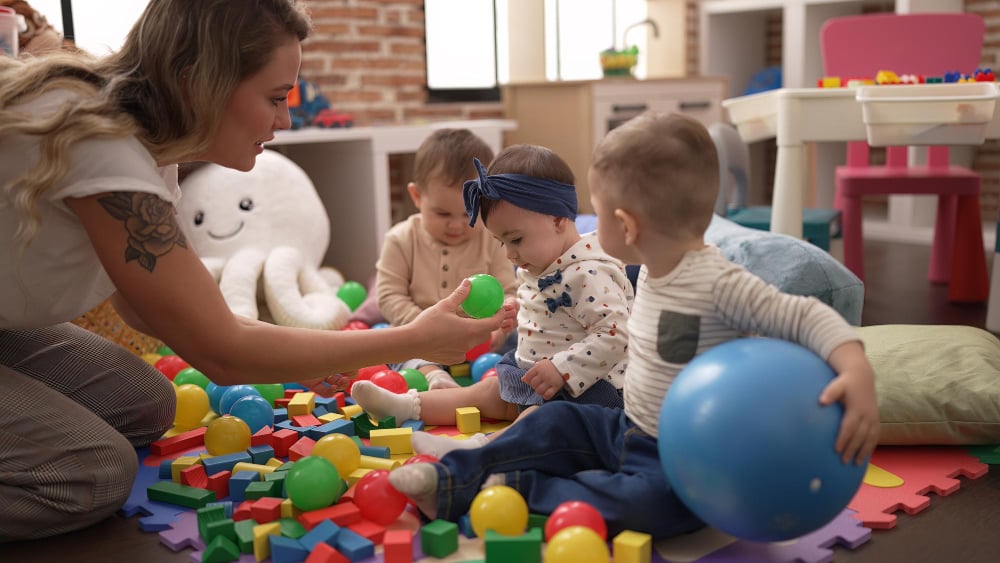
 How Montessori’s Simple Method Unlocks a Child’s Natural Learning Power
If you’ve ever watched a child’s face light up when they finally “get it,” you’ve witnessed something magical — that moment of connection between curiosity and understanding. In Montessori education, one of the most beautiful tools for nurturing that spark is the Three-Period Lesson — a deceptively simple, yet profoundly effective way to introduce new concepts.
From #language to #math, sensorial learning to practical life, this three-step approach helps children learn naturally, confidently, and joyfully — without pressure or rote memorization.
🌱 What Is the Three-Period Lesson?
Maria Montessori borrowed this framework from 19th-century #educator Édouard Séguin and refined it into something extraordinary. It’s built around three distinct stages that mirror how children absorb information:
-
Naming (Introduction) – “This is…”
The #teacher introduces a concept or object cl #early and calmly. For example, while presenting geometric solids, you might say: “This is a cube. This is a sphere.” -
Recognition (Association) – “Show me…”
Now it’s the child’s turn to show understanding. You might say: “Show me the cube,” or “Place the sphere on the tray.” Here, children are actively linking language to meaning through movement and experience. -
Recall (Demonstration) – “What is this?”
In the final period, you check for mastery. The teacher points to the object and asks, “What is this?” If the child can respond confidently, the learning has truly taken root.
It’s not a quiz — it’s a conversation. The goal is confidence, not correction.
🧠 Why the Three-Period Lesson Works So Well
The Three-Period Lesson reflects how children learn best: through repetition, exploration, and #freedom. Each stage moves from absorption to application to mastery, building a bridge between the senses and the intellect.
This approach aligns beautifully with the ideas discussed in Sensitive Periods in Montessori: Guiding Natural Learning  Buy Now $16.00. Sensitive periods — windows of intense curiosity and focus — are when children are most ready to learn. The Three-Period Lesson gives them just enough guidance without interruption, allowing their natural learning instincts to shine.
When a child is in a sensitive period for language, for example, the naming and repetition in the Three-Period Lesson perfectly fuel that #developmental drive. The result? Deep, joyful learning that sticks.
👶 From Infancy to Independence
You don’t need to wait for #preschool to begin using this method. Montessori principles can guide learning from the very start of life.
As explored in Montessori for Infants: Nurturing Independence from the Start, even babies experience sensitive periods — for movement, order, and language. Parents and caregivers can use “mini” versions of the Three-Period Lesson throughout daily routines:
-
Naming body parts while dressing (“This is your hand”)
-
Recognizing familiar objects (“Show me your ball”)
-
Encouraging recall (“What’s this?” while pointing to a favorite toy)
This gentle repetition helps infants build early understanding, confidence, and independence — all key Montessori outcomes.
🌍 Why Montessori Still Matters in a Fast-Paced World
In today’s world of constant screens, notifications, and multitasking, it can be easy to overlook the value of slow, mindful learning. The Three-Period Lesson stands as a quiet revolution against information overload.
As discussed in Why Montessori Still Matters in a Fast-Paced World, Montessori education teaches focus, patience, and intentionality — qualities that are increasingly rare but deeply necessary.
The Three-Period Lesson invites children to pause, observe, and connect deeply with what they’re learning. There’s no rush to “get to the next step.” The pace is set by the child — not the clock. And that’s what makes it timeless.
💬 What Parents Often Ask (and How to Answer)
Parents are often curious about what’s happening in the #classroom — especially when they see their child working quietly with wooden shapes or pouring beans from one bowl to another.
The FAQ: Parents Ask Montessori Teachers Buy Now $0.00 resource is a great tool for #educators who want to communicate these methods clearly. When explaining the Three-Period Lesson to families, emphasize that:
-
It supports natural learning — no memorization or testing required.
-
It helps build concentration, vocabulary, and confidence.
-
It allows children to learn through success rather than correction.
Parents love hearing that Montessori methods grow not just academic skills, but curiosity and self-trust.
🌟 Bringing the Magic to Life
The beauty of the Three-Period Lesson lies in its simplicity. Whether you’re guiding a #toddler or a six-year-old, this quiet ritual of naming, exploring, and recalling fosters connection and understanding.
For #teachers, it’s a reminder that teaching doesn’t mean telling — it means revealing.
For children, it’s an invitation to discover.
And for #parents, it’s proof that learning can be joyful, peaceful, and deeply human. Teachers looking for practical, classroom-tested strategies can deepen their practice with the Authentic Montessori in Action course.
So next time you pick up a pink tower cube or trace a sandpaper letter, remember: you’re not just teaching a concept — you’re guiding a child through the magic of discovery.
📲 Stay Connected
For more articles, training, and professional resources on inclusive education and child development, follow ChildCareEd on social media:
👉 TikTok
