Introduction
This short guide is for child care leaders and teachers who want simple, practical ways to help children be more independent. In Montessori settings, small everyday tasks like pouring, spooning, and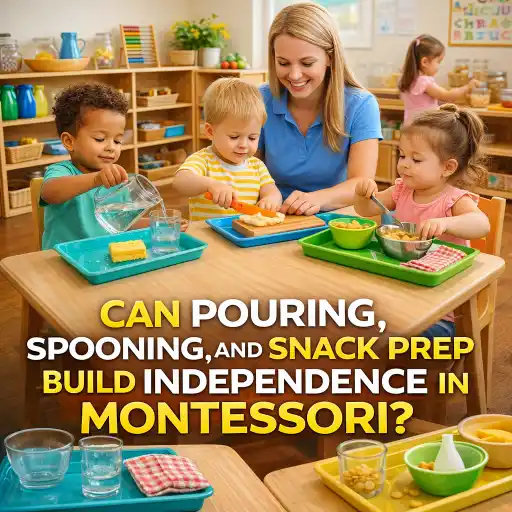 preparing snacks are powerful learning tools. These activities build coordination, confidence, and a sense of responsibility. You will find ideas for setting up space, teaching steps, avoiding common mistakes, and answering frequent questions. Remember: state requirements vary - check your state licensing agency.
We use the Montessori idea of Practical Life to teach real skills. See practical ideas and materials at Exploring Montessori Materials and tips for small spaces at How to Create Montessori Work Areas in Small Spaces. This article uses #Montessori #independence #practicallife #pouring #snackprep to highlight key ideas.
Why do pouring, spooning, and snack prep matter for children's growth?
Why it matters:
1. These tasks teach the brain and the hands to work together. Pouring and spooning help eye-hand coordination and fine motor control. That makes writing and self-care easier later.
2. They give children real responsibility. When a child sets their own snack or pours their water, they learn cause and effect and feel capable. Maria Montessori called these Practical Life activities that help children grow into confident adults; see background here: Montessori Practical Life Activities.
3. They are self-correcting and repeatable. A child can try pouring again and get better each time. That builds patience and concentration. The classic pouring progression is explained at Pouring Water.
Short list of benefits:
- Stronger motor skills
- Better independence at snack time
- Improved focus and calm
- Practical safety skills
How can we set up a safe, child-sized snack station and tools?
Set up your space so children can reach, choose, and return materials.
Key setup steps (use low shelves, trays, and small rugs):
- 🌿 Choose child-size tools: small pitchers, light bowls, plastic cups, small spoons. Use materials children can carry with two hands.
- 🧺 Put each activity on one tray so it is easy to carry and tidy. Trays act like work kits and limit pieces to what a child needs.
- 📚 Keep work areas grouped: Practical Life (snack), Sensorial, Language. For layout tips see Shelves, Rugs, and Trays and small-space ideas at How to Create Montessori Work Areas in Small Spaces.
- 🧯 Make safety easy: place nonbreakable items on low shelves, hot items only handled by adults, keep walking lanes clear.
- 🔁 Rotate and replace: put out fewer works and rotate weekly so children are not overwhelmed.
Practical checklist for a one-table snack station:
- Small pitcher and cup set
- Light bowl and small spoon
- Child-size cutting board and blunt knife for older toddlers
- Tray for crumbs and a small brush/dustpan
- Wet cloth and small bin for washing
For ideas about materials and how they fit the Montessori method, see Exploring Montessori Materials. And remember: state requirements vary - check your state licensing agency.
How should teachers teach and scaffold pouring, spooning, and snack prep?
Teaching is quiet, clear, and step-by-step. Use short lessons that the child can copy.
Simple teaching plan (3 parts):
- 👀 Demonstrate slowly: Kneel at child level. Show the whole task once, using calm hands and few words. Example: pouring water from a pitcher into a cup.
- 🤝 Invite practice: Say, “Now you try.” Offer help only if asked or if child is unsafe. Allow repetition. Pouring skills progress from dry (beans) to wet (water) as shown at Pouring Water.
- ✅ Close the lesson: Have the child return items to the tray and shelf. Praise process: “You poured carefully.”
How to scaffold by age:
- 2–3 years: spooning solids, carrying light cups, wiping small spills.
- 3–4 years: pouring between same-size cups, spreading, simple cutting with blunt tools.
- 4+ years: pouring into multiple cups, slicing soft fruit with supervision, leading simple snack setup.
Common mistakes and how to avoid them:
- ⚠️ Too much adult help: Wait and watch. If you step in too fast you stop learning.
- ⚠️ Materials too big or heavy: Use child-scale tools only.
- ⚠️ Too many choices at once: Offer 2–4 clear works and rotate the rest. See guidance on when children won’t choose work at When a child won’t choose work.
For more stepwise ideas and lesson language, look at Practical Life resources and lesson sequences like those listed by training centers (for example, see Montessori Practical Life Activities).
How do we know it’s working and what questions do providers ask?
Signs it’s working:
- Children set up and clean up with little help.
- They repeat a task to improve it (pour more carefully next time).
- Snack time runs smoother and children ask to help.
- Calmer classroom mood and longer focus times.
Simple ways to measure progress:
- Keep a short weekly note: who poured without help? who needs more practice?
- Use photos to show skill growth for families.
- Rotate in slightly harder steps and watch for success.
FAQ (short answers):
- Q: At what age can children pour water?
A: Start dry pouring at about 2 years, water pouring later when balance improves. See pouring progress at Pouring Water. - Q: What about spills?
A: Spills are part of learning. Teach wiping and provide a small spill kit so children learn responsibility. - Q: How do we include children with different needs?
A: Adapt tools and pace; Montessori is inclusive—see Montessori’s Inclusivity. - Q: How many tools should be out?
A: Fewer, clearer choices. 2–4 options per area is a good rule.
If you want more classroom layout and material ideas, check: How to Create Montessori Work Areas in Small Spaces and Exploring Montessori Materials. Use quick observation notes and share progress with families. And again: state requirements vary - check your state licensing agency.
To support your article’s focus on independence through Practical Life snack work (pouring, spooning, carrying trays, and clean-up), here are two Montessori4Teachers courses you can link right inside the text:
-
When you describe setting up a child-sized snack station (low shelves, trays, accessible tools, clear work areas), link The Prepared Environment: Montessori Class Design: https://www.montessori4teachers.com/courses-mastering-the-montessori-prepared-environment-3846.html
 Buy Now $16.00. (montessori4teachers.com Buy Now $16.00)
 -
When you coach teachers on how to present Practical Life lessons (slow demonstration, minimal words, inviting repetition, and building independence), link The Montessori Assistant’s Toolkit: https://www.montessori4teachers.com/courses-empowering-montessori-assistants-3847.html
Buy Now $40.00. (montessori4teachers.com Buy Now $40.00)
Conclusion
Pouring, spooning, and snack prep are small tasks with big returns. When you prepare the environment, teach in gentle steps, and let children try, they gain #independence and practical life skills that last. Start small, keep tools child-sized, and use short lessons. You will see children grow more confident, calm, and capable at snack time and beyond.
Further reading: NAMC practical life posts at Montessori Practical Life Activities and practical examples and classroom tips at Shelves, Rugs, and Trays.
- Montessori and the Importance of Hands-On Education
- Emphasis on Movement in Montessori Education
- Shelf Work in Montessori Education: Encouraging Independence and Learning
- Unlocking the Power of Practical Life: A Montessori Foundation
- How to Set Up a Montessori Shelf at Home
- Everyday Montessori
- Montessori Magic: Bringing Practical Life Skills to Life Through Play
