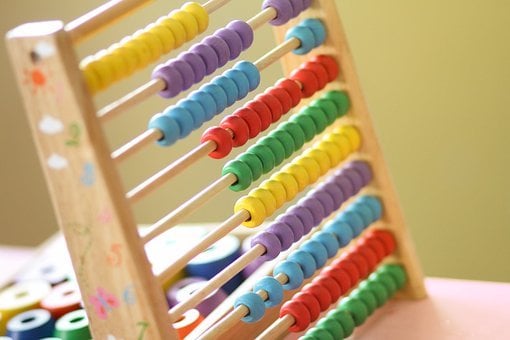
 For many adults, the word math brings back memories of worksheets, drills, and maybe even a little frustration. But in a Montessori #classroom, #math looks—and feels—very different. Instead of abstract numbers on paper, children handle golden beads, lay out colorful bead chains, and explore the beauty of numbers with their hands. This tactile, joyful approach doesn’t just teach math—it helps children truly fall in love with it.
Why Montessori Math Feels Different
At the heart of Montessori math is the belief that children learn best through concrete, hands-on experiences. Before they ever see equations, children touch and move materials that bring numbers to life.
-
Golden Beads help children understand place value. A single bead represents “one,” while a ten-bar, hundred-square, and thousand-cube show how numbers grow in scale.
-
Spindle Boxes give children the chance to physically group numbers and see zero as an empty set—making abstract concepts instantly understandable.
-
Bead Chains allow children to explore skip-counting, multiplication, and even square and cube numbers, long before they tackle these topics on paper.
When a child lays out a chain of beads and counts each one with delight, they aren’t memorizing—they’re experiencing math in a living, memorable way.
What the Research Says
Recent studies show that Montessori #students often outperform peers in math and problem-solving. Researchers attribute this to:
-
Active #engagement: Children discover math through exploration, not rote memorization.
-
Deeper understanding: By working from concrete to abstract, children grasp “why” math works, not just “how.”
-
Confidence building: Early success with hands-on materials fosters a positive attitude toward math, reducing anxiety later on.
In fact, Montessori math experiences align with what cognitive scientists say about learning: when multiple senses are engaged, learning sticks.
Real Moments of Discovery
In one classroom, a 5-year-old proudly used the golden beads to “build” the number 4,326. As she stacked the thousands cube, hundreds squares, tens bars, and ones beads, her #teacher asked, “How many tens are in 4,326?” Without hesitation, the child grabbed the corresponding bars and exclaimed, “Two tens!” That “aha” moment is exactly what Montessori math is all about—children seeing and feeling numbers instead of memorizing them.
Another classroom example: children using the bead chains to discover multiplication. Instead of chanting times tables, they laid out the bead chains, counted together, and joyfully realized that 5 bead bars repeated 3 times equals 15. This natural discovery creates excitement and builds mathematical intuition.
Try This Activity: Skip-Counting with Bead Chains
Objective: To introduce multiplication and skip-counting in a joyful, hands-on way.
Materials:
-
Montessori bead chains (e.g., 3s, 4s, 5s)
-
Number labels (optional)
How to Do It:
-
Choose a bead chain (say, the chain of 5). Lay it out on the floor or a mat.
-
Invite the child to count the beads one by one. Then, guide them to count by fives.
-
Place number labels (5, 10, 15, etc.) at each interval.
-
Ask: “What do you notice?” Encourage them to see the pattern: skip-counting #leads to multiplication.
Why It Works:
This activity bridges the gap between concrete experience (touching beads) and abstract understanding (multiplication facts). It’s joyful, interactive, and deeply memorable.
Taking the Next Step in Your Practice
For #educators who want to deepen their skills, the Math Foundations in Early Childhood  Buy Now $16.00 course is an invaluable resource. For practical ideas about teaching toddlers with hands-on materials and to learn about Georgia-approved training options, see the Math and Montessori guide.
In this intermediate-level course, you’ll discover:
-
Practical strategies for weaving math into daily routines.
-
Hands-on activities that inspire problem-solving and exploration.
-
Techniques to create math-rich environments that support every child’s #developmental-milestones.
By strengthening your understanding of #early math education, you’ll not only boost your teaching effectiveness but also #nurture children’s long-term academic #growth.
Unlocking the Joy of Numbers
So, can Montessori math unlock a love of numbers? The answer is a clear and joyful yes. When children explore math with their hands, curiosity blossoms, confidence grows, and abstract thinking develops naturally. With the right tools and training, educators can transform math from something children “have to do” into something they love to discover. #early-childhood #teachers
✨ Stay connected! Follow ChildCareEd on social media for more resources, training opportunities, and updates to help you provide the best care for children.
- Unlock the Power of Montessori
- Understanding Montessori Materials
- The Importance of Hands-On Learning in Montessori Education
- Individualized Learning Approaches in Montessori Classrooms
- Montessori Theory in Practice: Bringing Child-Centered Learning to Life
- Unlocking Your Path to Montessori: The Ultimate Guide to Becoming an Educator
- Elementary Montessori Education: A Unique Approach to Learning
- Raising the Montessori Way: A Family Win
- Montessori Magic: Bringing Practical Life Skills to Life Through Play
- Can Montessori Math Unlock a Love of Numbers?
- Are the Top 5 Montessori Myths Holding You Back?
- What Employers Love About Montessori Alumni
- ✨ The Magic of the Three-Period Lesson Explained
- Montessori Math vs. Traditional Math: Key Differences
