Montessori #classrooms are renowned for their hands-on, child-centered approach to education, and #math instruction is no exception. Grounded in sensori-motor pedagogy and the prepared environment, the Montessori method uses concrete, #sensory experiences to build foundational skills and a deep conceptual understanding of number and operations. This article outlines practical strategies to integrate math instruction in Montessori settings and points to ChildCareEd courses such as Montessori Made Simple Buy Now $35.00 and Math Foundations in Early Childhood  Buy Now $16.00 that support curriculum planning and classroom implementation for educators.
Why does math matter in Montessori classrooms?
Math is an essential component of a child’s #early-learning journey. It helps children #develop critical thinking, problem-solving, and reasoning skills. Montessori math materials are designed to:
- Build a strong foundation through hands-on experiences.
- Promote independence and confidence.
- Create connections between abstract concepts and tangible experiences.
What are the key Montessori math materials and their purposes?
Montessori classrooms use specialized tools to introduce #math-concepts tangibly and engagingly. Here are some essential materials and their purposes:
- Number Rods: Teach counting, number sequencing, and basic addition and subtraction.
- Sandpaper Numbers: Help children associate numerals with their corresponding quantities.
- Golden Beads: Introduce place value and operations like addition, subtraction, multiplication, and division.
- Binomial and Trinomial Cubes: Lay the groundwork for understanding algebraic concepts.
How can teachers incorporate math instruction in a Montessori setting?
1. How should teachers start with the basics?
Young children begin with simple counting and number recognition activities. Incorporate activities like:
- Sorting objects by size, color, or shape.
- Using tactile materials like sandpaper numbers and counting beads.
- Singing number songs and rhymes.
2. When and how should teachers progress to more complex concepts?
As children’s skills grow, introduce more complex ideas like addition, subtraction, and place value. Use Montessori tools such as:
- Golden Beads to demonstrate the decimal system.
- Stamp Game for dynamic addition and subtraction activities.
3. How can teachers encourage productive exploration?
Give children the #freedom to explore math materials independently. This fosters curiosity and helps them learn at their own pace. Always provide guidance when necessary but allow space for self-discovery.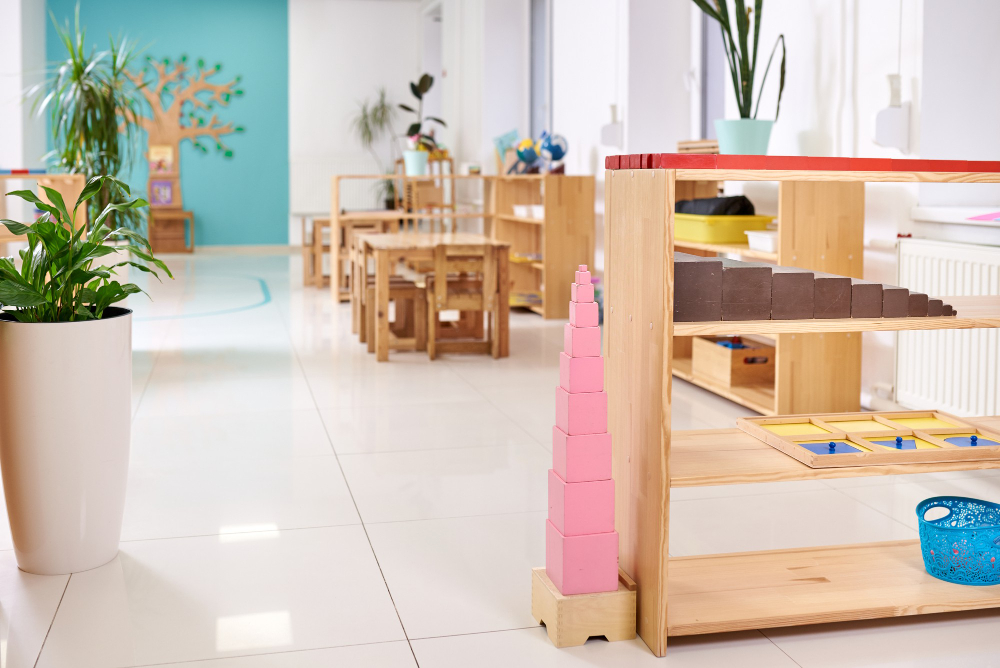
4. How can teachers connect math to real-world activities?
Link math concepts to everyday life to show their relevance. Examples include:
For older children, integrate math into interdisciplinary Cosmic Education lessons that connect mathematical ideas to science, geography, and practical life, deepening meaning and fostering a sense of responsibility to the community and environment.
- Measuring ingredients during cooking activities.
- Counting objects during nature walks.
- Exploring shapes and patterns in the environment.
How do Montessori materials build number sense?
Montessori materials are deliberately sequenced to move learners from sensorimotor experience to symbolic representation, a progression that builds robust number sense. For example, the Number Rods provide an embodied magnitude experience: children perceive length differences while naming quantities, which supports cardinality and ordinality. Sandpaper Numbers combine tactile tracing of numerals with counting of discrete objects so the symbolic numeral is rooted in quantity. Golden Beads make the base-ten system visible and manipulable, enabling learners to perform operations by physically grouping and regrouping units, tens, hundreds, and thousands. These concrete operations reduce working-memory load and allow children to internalize procedural regularities before transitioning to abstraction.
When planning lessons, sequence materials to honor sensitive periods for order and sensori-motor exploration. For practical guidance on recognizing these developmental windows and adapting presentations to match a child’s current sensitivities, see the ChildCareEd article Sensitive Periods in Child Development. Begin with materials that emphasize one-to-one correspondence and conservation (Number Rods, spindle boxes, simple bead bars), then provide transitional activities that ask children to represent quantities with materials and symbols concurrently (sandpaper numerals plus counters). In upper preschool and elementary mixed-age groups, materials such as the Stamp Game and Golden Beads can scaffold multi-digit operations and place-value reasoning without premature reliance on standard algorithms. For classroom implementation guidance, see the ChildCareEd article Montessori Math: Preparing Children for Abstract Thinking and Cognitive Development and the overview What is Montessori? which situates materials within the prepared environment.
How can teachers assess math progress in a Montessori classroom?
Assessment in Montessori settings is observational, competency-focused, and formative. Effective assessment practices combine systematic observation, work sampling, and brief performance tasks with materials. Practitioners should keep anecdotal records that note independent use of materials, demonstrated strategies (for example, whether a child decomposes 10 into 7+3 when using beads), and error patterns that suggest conceptual gaps (confusion about place value, inconsistent one-to-one correspondence). Use regular work cycles to observe transfer: does the child move from manipulatives to paper notation and back with understanding? Are strategies becoming more efficient and generalized?
Design short, authentic assessments that use the same Montessori materials children use for learning (e.g., ask a child to use Golden Beads to show 243 and then explain the grouping). Document performance across several cycles to account for variability in concentration and daily readiness. For practical classroom ideas about structuring observation and documenting progress, consult the ChildCareEd article The Montessori Classroom: Fostering Independence and a Love for Learning and Shelf Work in Montessori Education for approaches to organizing materials and recording independent mastery.
What training opportunities are available?
To enhance your understanding of math instruction in a Montessori classroom, consider enrolling in specialized training courses. ChildCareEd offers courses that align with the instructional practices described above, for example, Implementing the Montessori Curriculum Buy Now $32.00 (classroom implementation strategies) and advanced short courses such as Montessori Made Simple Buy Now $35.00. These courses provide practical examples of sequencing materials, designing independent work cycles, and documenting mastery. Always verify any specific credential or registry requirements with your state or employer before assuming a training meets a regulatory requirement.
To enhance your understanding of math instruction in a Montessori classroom, consider enrolling in specialized training courses. Montessori4Teachers offers a range of courses tailored to child care professionals, including those focused on curriculum planning and teaching math concepts effectively.
What resources support Montessori math instruction?
Montessori4Teachers provides excellent resources to support math instruction in the classroom. Check out the following. Also see the ChildCareEd article Everyday Montessori for classroom math activity ideas and simple daily math extensions.
- Educational Articles: Expand your knowledge with insightful articles like Understanding Montessori Materials.
What are the benefits of Montessori math instruction?
Integrating math instruction in a Montessori classroom not only #nurtures children’s cognitive development but also builds their confidence and enthusiasm for learning. By offering hands-on materials, encouraging exploration, and linking concepts to real-world applications, #teachers can create a rich and engaging math experience.
For more ideas and training opportunities, visit Montessori4Teachers. Together, let’s inspire the next generation of mathematical thinkers.
Summary: How can educators apply these practices in the classroom?
Montessori math instruction is intentional sequencing plus opportunities for independent, sensori-motor learning. To apply these practices, begin by ensuring materials are accessible and sequenced from concrete to symbolic; observe students across multiple work cycles to document mastery and note strategy use; plan transitional activities that encourage children to make connections between manipulatives and written representation; and pursue targeted professional development to refine materials presentation and assessment. ChildCareEd courses referenced above provide concrete lesson plans and classroom strategies that can be adapted for mixed-age groups. By combining a prepared environment, sensitive observation, and carefully chosen materials, teachers can foster deep conceptual understanding and long-term mathematical fluency in their learners. #Montessori #math #assessment #materials #professionaldevelopment
- Montessori Foundations
- Montessori Unveiled: Demystifying the Method for Parents
- Inclusive Montessori: Supporting Diverse Learners in the Classroom
- Engaging Parents in the Montessori Toddler Classroom
- Math Foundations in Early Childhood
- Mastering Observation Techniques in the Montessori Classroom
- The Prepared Environment: Montessori Class Design
- Unlock the Power of Montessori
- The Montessori Classroom: Theory to Practice
- Incorporating Math Instruction in the Montessori Classroom
- The Importance of Active Play in the Montessori Classroom
- Exploring the Comprehensive Montessori Curriculum
- Montessori Math: Preparing Children for Abstract Thinking and Cognitive Development
- Emphasis on Movement in Montessori Education
- The Montessori Classroom: Fostering Independence and a Love for Learning
- Shelf Work in Montessori Education: Encouraging Independence and Learning
- Everyday Montessori
- Raising the Montessori Way: A Family Win
- Can Montessori Math Unlock a Love of Numbers?
