Introduction
Montessori mixed-age classrooms can feel like a warm family. When they work well, children learn from each other, grow in confidence, and build real skills. This article is for directors and child care providers who want clear, practical steps to make mixed-age Montessori work in your program.
Key ideas you will see here: 1) why mixed-age settings matter, 2) main benefits, 3) how to set up the r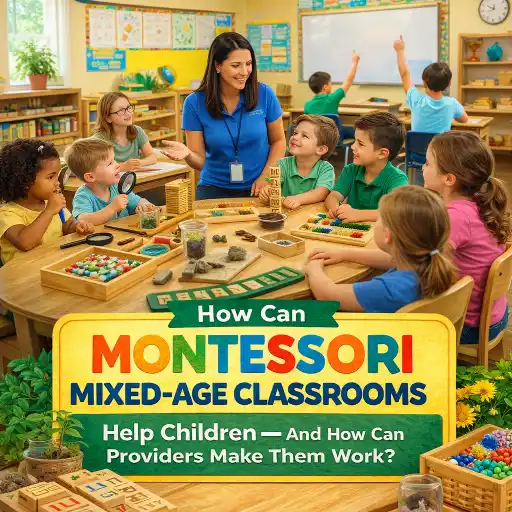 oom, and 4) how to guide routines, staff, and families so things run smoothly. You will also find short lists of common mistakes and simple fixes.
Here are five words to remember: #Montessori #mixedage #independence #leadership #community.
Why does mixed-age Montessori matter — and why should my program try it?
1. Mixed-age grouping builds relationships over time.
Older children mentor younger ones. Younger children copy and learn faster by watching older peers. Research shows children in mixed-age classrooms have more prosocial behavior and less aggression than same-age groups; see the research overview at ECRP for details.
2. It supports deeper learning and social skills.
Montessori mixed-age rooms let kids practice real roles: teacher, learner, helper. These roles grow #leadership and social thinking. You can read more about the Montessori idea of mixed ages on resources like Learning in Layers: The Power of Mixed Ages and the ChildCareEd course Working With Mixed Age Groups  Buy Now $24.00.
3. It helps families and programs.
Siblings can stay together and children stay with one teacher longer, which builds trust. For programs, mixed-age classrooms often reduce transitions and strengthen community, as explained in Working with Mixed Age Groups.
Why it matters: mixed-age Montessori is not just a nice idea. It supports long-term social growth, stable relationships, and layered learning that matches each child’s pace.
What real benefits do children and programs get in mixed-age Montessori classrooms?
1. Peer teaching and confidence.
- 😊 Older kids teach younger ones and deepen their own learning.
- 🙂 Younger kids see bigger tasks and try harder.
2. Individual pace and mastery.
Children work at their own speed. Montessori materials are self-correcting so kids can repeat until they master a skill. The Montessori curriculum guide Implementing the Montessori Curriculum Buy Now $32.00 covers how to make activities that suit many ages.
3. Better social outcomes.
Research shows mixed-age classrooms often have more prosocial play and fewer children who feel isolated; see the study at ECRP. ChildCareEd articles also highlight benefits like leadership and community in mixed groups (Learning in Layers).
4. Program gains.
- 🔹 Staff build deeper relationships with children because kids stay longer with the same adult.
- 🔸 Families have fewer transitions when children stay in one room across years.
5. Practical classroom wins.
Mixed-age rooms make it possible to offer layered lessons, rotate materials, and create leadership jobs like shelf-straightener or plant helper. For ready-to-use lessons and activities, see ChildCareEd resources such as the Montessori lesson plan Exploring Our World Buy Now $0.00.
How should providers prepare the classroom and materials so mixed ages thrive?
1. Set up a calm, beautiful prepared environment.
Use low shelves with a few choices per shelf. Child-sized tools and real materials help children do tasks by themselves. ChildCareEd explains room design in Creating the Montessori Prepared Environment.
2. Organize zones and safety areas.
- 🙂 Quiet work zones with rugs and small trays.
- 😊 Movement or messy zones separated by low shelves or mats.
- 🔸 Age-sensitive tools: small parts kept in zones where older children can use them safely.
3. Limit materials and rotate.
Keep 6–10 works visible per area. Rotate one shelf each week to renew interest. Fewer choices help focus and protect materials.
4. Make independence easy.
- 🔹 Child-size pitchers, spoons, brooms.
- 🔸 Clear labels and pictures for steps (wash hands, choose work, return work).
5. Prepare staff with step-by-step roles.
Plan short lesson presentations, observation time, and how adults will support peer teaching. ChildCareEd course Montessori Essentials: Mixed-Age Mastery Buy Now $16.00 gives practical training on all this.
How do teachers run cycles, manage behavior, and avoid common pitfalls?
1. Protect a work cycle.
Plan a long, mostly uninterrupted work period. For preschool children, aim for at least 60–120 minutes. Shorter blocks work for toddlers. See concrete tips in How do I run a Montessori work cycle. Remember: state requirements vary - check your state licensing agency.
2. Use simple routines and visuals.
- 🙂 Morning routine: greet, put away, choose a work.
- 😊 Transition cues: soft chime, 2-minute picture countdown.
- 🔸 Clean-up song or short checklist for returning work.
3. Teach Grace and Courtesy often.
Short role-play lessons like "May I join you?" or "I’m working now" cut down conflicts. ChildCareEd’s piece on preventing "big kid vs. little kid" conflicts has useful scripts (How to Prevent “Big Kid vs. Little Kid” Conflicts).
4. Common mistakes and quick fixes.
- ⚠️ Too many materials out — fix: simplify and rotate weekly.
- ⚠️ Over-teaching whole group — fix: use brief small-group lessons and observations.
- ⚠️ Not supervising transitions — fix: assign staff posts and pictures at transition points.
5. Use peer teaching and leadership roles.
Give older children jobs (shelf helper, line leader) and scripts for helping younger peers. This builds #leadership without making older kids bossy.
Conclusion and quick FAQ
Summary checklist for providers:
- 🔹 Create a prepared, calm environment with low shelves and child tools.
- 🙂 Protect a long, focused work cycle each morning.
- 🔸 Teach Grace and Courtesy and use peer teaching.
- 😊 Train staff and share simple rules with families—state requirements vary - check your state licensing agency.
FAQ
- Q: How wide should the age span be? A: Three years is common (e.g., 3–6). It gives good peer models and variety.
- Q: What if I have limited space? A: Use zones, rotate materials, and protect one long work block.
- Q: How many adults? A: One lead + assistant is ideal for larger mixed groups. Small groups can run with one thoughtful guide.
- Q: Where can I get more training? A: ChildCareEd offers courses like Working With Mixed Age Groups Buy Now $24.00 and Montessori Essentials: Mixed-Age Mastery Buy Now $16.00.
Mixed-age Montessori classrooms take planning and patience. They pay off with stronger friendships, confident children, and a kinder classroom culture. Start with small changes: one prepared shelf, one short Grace and Courtesy lesson, and one protected work period. You will see growth in #independence, sharing, and #community.
- Understanding Multi-Age Classrooms in Montessori Education
- Montessori For All
- Long-Term Benefits for Students: Montessori Education
- Classroom Pets in Montessori Education
- Understanding Mindful Supervision in Montessori Settings
- Challenges in Implementing Montessori Practices
- Unlocking Your Path to Montessori: The Ultimate Guide to Becoming an Educator
- Montessori & You: A Perfect Match?
- Learning in Layers: The Power of Mixed Ages
