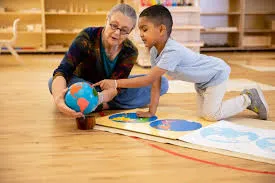
 What is Montessori geography and why does it matter?
Montessori education fosters a child’s natural curiosity and love for learning. Montessori geography uses hands-on materials to make the world accessible and meaningful to young learners. For practical training, see our courses Montessori Foundations  Buy Now $10.00 and Montessori Cultural Activities Buy Now $24.00. This approach helps children develop spatial awareness, cultural understanding, and a sense of place. Tags: #Montessori #geography #culture #empathy #learning
Why is geography important in early childhood education?
Geography in early childhood education goes beyond memorizing maps and naming continents. It helps children develop:
- A sense of place and direction
- An appreciation for different cultures and traditions
- Spatial awareness and problem-solving skills
- A connection to the natural world and environmental consciousness
By introducing geography concepts early on, children gain a lifelong interest in learning about the world and their role within it.
How does the Montessori approach teach geography?
In the Montessori classroom, geography is taught through sensory-based and hands-on materials that make abstract concepts tangible for young learners. This approach ensures that children develop a concrete understanding before progressing to more complex geographical ideas. Learn more about Montessori materials in Understanding Montessori Materials. The Montessori geography curriculum is typically divided into two main categories:
Physical geography in Montessori:
Physical geography focuses on the earth’s features, landforms, and natural elements. Montessori classrooms use materials such as:
- Globe Activities: Children begin with the sandpaper globe to distinguish land from water, then progress to the colored globe, which represents continents. See also The Montessori Classroom: A World Designed for Discovery.
- Puzzle Maps: These maps introduce continents, countries, and regions in a tactile way, making learning interactive and engaging.
- Land and Water Forms: Hands-on models help children understand geographical features such as islands, lakes, peninsulas, and straits.
- Nature Walks and Outdoor Exploration: Encouraging children to observe their surroundings deepens their appreciation for geography in real life.
Cultural geography in Montessori:
Cultural geography introduces children to the people, traditions, and customs of different regions. Montessori classrooms use a variety of tools to bring cultural geography to life, including:
- Continent Boxes: These contain artifacts, photos, currency, and traditional clothing from different continents, offering a hands-on learning experience.
- Flags and Landmark Models: Teaching children about flags and famous landmarks helps them recognize important symbols of different countries.
- Songs, Stories, and Food Tasting: Experiencing music, literature, and cuisine from around the world fosters a deep appreciation for cultural diversity.
- Celebrations and Festivals: Exploring global holidays and traditions enhances cultural understanding and inclusivity.
What are the benefits of Montessori geography learning?
Montessori geography supports children’s development in multiple ways:
- Encourages Curiosity and Exploration: Interactive materials and real-world connections inspire children to learn about different places.
- Promotes Fine Motor Skills: Manipulating puzzle maps and landform models strengthens hand-eye coordination.
- Builds Language and Vocabulary: Learning geographical terms enhances communication and literacy skills.
- Supports Social and Emotional Development: Understanding different cultures fosters empathy, respect, and a sense of global citizenship. Read more in Montessori Education and Brain Development.
- Enhances Cognitive Skills: Sorting, categorizing, and identifying geographical elements develop problem-solving abilities and critical thinking.
How can I introduce Montessori geography at home or in the classroom?
Teachers and parents can incorporate Montessori geography activities into daily learning routines using simple strategies:
- Provide a globe and encourage children to explore different countries and continents.
- Create DIY land and water forms using sand, clay, and water to demonstrate geographical features.
- Use storybooks and puzzles that introduce maps, cultures, and traditions from around the world.
- Encourage children to participate in cooking activities featuring recipes from different cultures.
- Explore Montessori geography resources and training to deepen understanding and engagement.
How do Montessori geography materials and lessons progress by age and skill?
Montessori geography lessons are sequenced to match children's sensory and motor development. Early work focuses on simple, concrete contrasts: land vs. water with a sandpaper globe or tactile land-and-water trays. As children's fine-motor control and vocabulary grow, activities progress to puzzle maps, continent and country nomenclature, and labeled map outlines. Teachers observe sensitive periods for order and movement and introduce increasingly abstract representations only when a child demonstrates readiness. Practical classroom examples include matching country outlines to physical objects, tracing coastlines with fingers before moving to drawing, and combining map work with related cultural artifacts to support memory and contextual learning. For guidance on designing age-appropriate progressions and the prepared environment, see Tiny Tots, Big Learning and our course Sensitive Periods in Montessori Buy Now $16.00.
How can educators adapt Montessori geography for diverse learners and inclusion?
Adapting geography lessons begins with careful observation and task analysis. Break tasks into perceptual and motor steps (for example: 1) identify land vs. water by touch, 2) match tactile pieces to a map, 3) name the continent). Use multisensory supports for learners with diverse needs: larger tactile pieces, high-contrast maps, audio recordings of place names, and one-on-one guided practice. Pair geography with meaningful cultural materials—objects, music, or food—so that vocabulary and concepts have context. Use formative observation rather than timed assessments; record the child’s independent performance and scaffold the next step. For strategies that support inclusion and classroom adaptation, consult our course Inclusive Montessori Buy Now $16.00 and article Unlock the Power of Montessori. These resources provide practical adaptations and examples of differentiated geography work.
Where can educators find Montessori geography training and resources?
Child care professionals can build practical skills through short, online ChildCareEd courses that focus on Montessori principles and classroom implementation. Relevant ChildCareEd courses include Implementing the Montessori Curriculum Buy Now $32.00, Montessori Cultural Activities, and Montessori Made Simple Buy Now $35.00. For classroom design and materials guidance, review What Is Montessori? and The Importance of Hands-On Learning in Montessori Education. Confirm course acceptance with your state registry or employer when a training is required for licensing or professional development.
For educators looking to enhance their knowledge of Montessori geography instruction, Montessori4Teachers.com offers comprehensive training courses that provide practical strategies. Check out our Implementing the Montessori Curriculum training here Buy Now $32.00.
Additionally, Montessori educators and parents can benefit from valuable Montessori resources to support interactive and engaging learning experiences, Environmental Adaptations Checklist to Promote Child Participation Buy Now $0.00.
For further reading on Montessori and its impact on early childhood development, explore our featured article on Individualized Learning Approaches in Montessori Classrooms.
Stay connected for Montessori resources:
Join our community and stay updated on the latest Montessori teaching techniques, resources, and training opportunities! Follow us on Pinterest for more Montessori activity ideas and inspiration.
Montessori geography offers young children an enriching and meaningful way to explore the world. By engaging with hands-on materials and cultural experiences, children develop a lasting curiosity and appreciation for geography, setting the stage for lifelong learning and global awareness.
Summary: What should educators remember about Montessori geography?
Practical takeaways: begin with concrete, sensory experiences; observe sensitive periods and introduce abstraction gradually; integrate cultural artifacts to give maps meaning; adapt materials to support diverse learners; and document progression through observation rather than timed tasks. Use short, targeted professional development courses to build skills and always verify acceptance of a course with your state registry or employer when training is required. These steps help children build spatial reasoning, cultural competence, and a lifelong interest in the world.
- Understanding Montessori Materials
- Exploring the Comprehensive Montessori Curriculum
- Understanding Montessori Materials
- Montessori Theory in Practice: Bringing Child-Centered Learning to Life
- The History of Montessori
- Shelf Work in Montessori Education: Encouraging Independence and Learning
- Understanding Montessori’s Vision of Childhood
- A Montessori Day: Calm, Curious, Connected
- Montessori Magic at Home: Tips for Every Age
- Elementary Montessori: Fostering Curiosity & Responsibility
- Looking for a Hands-On Hispanic Heritage Activity for Kids?
