Montessori education, developed by Dr. Maria Montessori in the early 20th century, emphasizes hands-on, self-directed learning. Central to this approach are the unique learning tools known as Montessori materials. Read how Montessori theory guides materials. These materials are meticulously designed to support independent exploration and cognitive development in children. Learn core methods in Montessori Made Simple Buy Now $35.00 and how to set up effective learning spaces in The Prepared Environment  Buy Now $16.00.
What Are Montessori Materials?
Montessori materials are educational tools crafted to facilitate learning through active engagement. Each material serves a specific purpose, guiding children toward understanding abstract concepts by interacting with concrete objects. These materials are characterized by:
- Self-Correction: Materials are designed to allow children to identify and correct their own errors, fostering problem-solving skills and independence.
- Isolation of Difficulty: Each material focuses on a single concept or skill, enabling children to master one aspect of learning at a time.
- Aesthetic Appeal: Attractive and well-crafted materials draw children's interest and encourage repeated use.
- Progressive Complexity: Materials are organized to increase in complexity, aligning with the child's developmental stages.
What categories of Montessori materials are there?
Montessori materials span various areas of learning, each targeting specific developmental needs: Explore the comprehensive Montessori curriculum
What are the main categories of Montessori materials and examples?
Practical Life: These tools help children develop everyday life skills, promoting independence and coordination. Examples include pouring exercises (using jugs and cups to practice transferring liquids), dressing frames (buttons, zippers, laces), and child-sized cleaning tools (brooms and dustpans).
Sensorial: Designed to refine the senses and assist children in distinguishing and categorizing sensory information. Examples include the Pink Tower (visual discrimination of dimensions), sound cylinders (auditory discrimination), and color tablets (color recognition and gradation).
Language: Tools that support reading, writing, and communication—sandpaper letters (tactile letter forms), the Moveable Alphabet (constructing words; learn more), and object-picture matching cards for vocabulary building.
Mathematics: Concrete materials that scaffold abstract math—number rods (quantities and sequence), golden beads (place value and arithmetic), and fraction insets (parts and wholes).
Cultural: Materials that introduce geography, science, art, and music—puzzle maps, life-cycle charts, and art reproductions that foster a global perspective and curiosity.
What are the purposes, benefits, and developmental supports o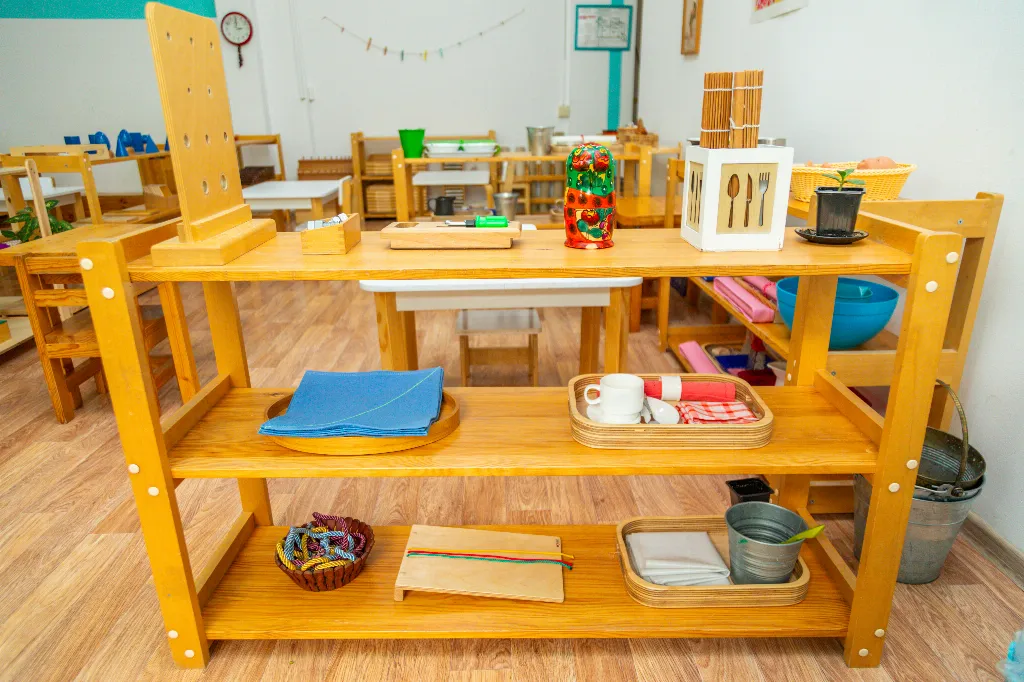 f Montessori materials?
Montessori materials are integral to the educational environment, offering numerous benefits and supporting developmental domains when selected and presented with domain-specific aims.
- Encourage Active Learning: Children learn by doing, which enhances retention and understanding.
- Promote Independence: Self-correcting materials empower children to assess their own work without relying on adult intervention.
- Develop Concentration: Engaging tasks require focus, gradually extending children's attention spans.
- Foster Fine Motor Skills: Manipulating materials hones hand-eye coordination and dexterity.
- Build Confidence: Mastery of materials leads to a sense of accomplishment and self-assurance.
Cognitively, concrete manipulatives such as number rods and golden beads scaffold abstract thinking by linking quantity to physical models. For language, sandpaper letters and the Moveable Alphabet provide multisensory pathways to phonemic awareness and early encoding. Sensorimotor and perceptual refinement are targeted by sensorial materials (for example, the Pink Tower and color tablets) that isolate single variables—size, color, or sound—so children can discriminate and classify sensory input more precisely.
Fine-motor and praxis skills are strengthened by practical-life exercises (pouring, dressing frames, child-sized tools) that build bilateral coordination and hand strength necessary for handwriting and self-care. Social-emotional skills develop through choice, turn-taking, and Grace and Courtesy practice; executive function is supported by sequential, self-correcting tasks that require planning and error monitoring. Observe which domain the child is engaged in and rotate or adapt materials to present a just-right challenge, and modify materials (larger knobs, tactile enhancements, visual supports) for diverse learners while keeping the pedagogical goal intact.
How can caregivers implement Montessori materials at home?
Parents can incorporate Montessori principles by providing appropriate materials and creating a conducive learning environment:
- Select Age-Appropriate Materials: Choose tools that align with your child's developmental stage and interests.
- Organize a Dedicated Space: Arrange materials on low shelves within a clutter-free area to encourage independent access and exploration. Learn more about shelf work in Montessori classrooms.
- Demonstrate Proper Use: Show your child how to use each material, then allow them to explore it independently.
- Encourage Routine: Establish regular times for engaging with the materials to build consistency and structure.
- Observe and Adapt: Pay attention to your child's interactions and adjust the selection of materials to meet their evolving needs and interests. See practical tips for Montessori at home.
Summary: What are the key takeaways about Montessori materials?
Montessori materials are design-focused tools that present a single, isolatable skill in a concrete form and offer self-correction so learners can internalize standards of correctness. The teacher's role is to prepare the environment, present materials with clear, brief demonstrations, and observe to sequence materials to each child's sensitive periods. In practice, prioritize safety and accessibility: keep materials on low shelves, select items appropriate to the child’s current interests and abilities, and adapt for diverse needs. Use observation to decide when to introduce more complex materials and when to revisit foundational activities. By aligning materials to developmental domains and providing a consistent, ordered environment, caregivers can foster concentration, independence, and intrinsic motivation.
Further Resources
For those interested in deepening their understanding of Montessori materials and their application, consider exploring the following resources:
- Training Opportunity: The Prepared Environment: Montessori Class Design Buy Now $16.00 – Learn the tools to craft a nurturing and stimulating learning space that supports holistic child development and leaves children excited to learn every day!
- Educational Resource: Six strategies for active supervision of mixed ages. – This poster is a great reminder of the essential elements of active supervision.
- Informative Article: Respect for the Child: A Foundational Belief in Montessori Education- This article explores the meaning of respect for the child in Montessori education, its benefits, and practical ways educators and parents can embody this principle.
- Teach the Montessori Way: A Practical Guide
- Montessori Foundations
- Montessori Assistant Training
- Understanding Montessori's Approach to Child Development
- Mastering Observation Techniques in the Montessori Classroom
- Intro to Montessori: Philosophy, Principles, and Practices
- Montessori Unveiled: Demystifying the Method for Parents
- Engaging Parents in the Montessori Toddler Classroom
- The Prepared Environment: Montessori Class Design
- Raising Peaceful Learners: The Montessori Advantage
- The Montessori Classroom: Theory to Practice
- Understanding Montessori’s Approach to Child Development
- Understanding Montessori Materials
- Incorporating Math Instruction in the Montessori Classroom
- Montessori Education vs. Traditional Preschool
- The Importance of Hands-On Learning in Montessori Education
- Exploring the Comprehensive Montessori Curriculum
- Understanding Normalization in Montessori Education
- Understanding Montessori Materials
- Montessori Theory in Practice: Bringing Child-Centered Learning to Life
- Understanding Peer Learning in Montessori Education
- Understanding Sensitive Periods in Montessori Education
- The Transformative Power of Montessori
- Understanding the Basis and Benefits of Montessori Education
- Montessori & You: A Perfect Match?
