Montessori education, developed by Dr. Maria Montessori, emphasizes child-led, experiential learning. Central to this approach is hands-on learning, where children engage directly with materials and their environment. This method fosters deep understanding, independence, and a lifelong love for learning. ChildCareEd offers practical trainings to help educators apply these principles, for example Montessori Foundations  Buy Now $10.00 and Montessori Made Simple Buy Now $35.00, which focus on materials, the prepared environment, and facilitation techniques for classroom practice. For summaries of research documenting academic and social outcomes in Montessori settings, see research on Montessori effectiveness.
What are the benefits of hands-on learning in Montessori education?
Hands-on learning in Montessori education offers numerous advantages:
- Enhanced Cognitive Development: Manipulating materials helps children grasp abstract concepts concretely. Montessori math strategies illustrate how concrete materials are used to scaffold numerical ideas and prepare children for later abstract thinking.
- Improved Fine Motor Skills: Activities like pouring, threading, and building refine coordination.
- Encouragement of Independence: Children choose tasks, fostering decision-making and self-reliance.
- Promotion of Problem-Solving Skills: Interactive tasks require critical thinking and adaptability.
How do you implement hands-on learning in a Montessori classroom?
To effectively incorporate hands-on learning:
- Prepare the Environment: Organize materials that are accessible and inviting.
- Offer Diverse Materials: Provide a range of tools to cater to various interests and developmental stages.
- Facilitate, Don't Direct: Guide children subtly, allowing them to explore and discover independently.
How do you set up a prepared environment that supports hands-on learning?
The prepared environment is the practical foundation for Montessori hands-on learning. Start by arranging low, open shelving and grouped activity trays so children can see and choose materials independently. Prioritize a small number of well-chosen activities per learning area to reduce overstimulation and support concentration. Include natural, sensorial materials and a few open-ended items that invite manipulation and exploration. Ensure trays and tools are scaled to children’s hands and labeled clearly; this supports autonomy and reduces adult prompting. For guidance specifically focused on toddler-aged children — including scaled furniture, toileting independence setups, and sensorimotor activity examples — see Understanding Montessori Toddler Education. For concrete implementation:
- Design predictable work areas (practical life, sensorial, language, math) so children understand where to find and return materials. Include cultural areas such as geography to foster curiosity and cultural awareness through hands-on maps, puzzles, and landform materials; see our article on Montessori approaches to geography learning for concrete classroom activities and materials.
- Control variety: offer 3–5 choices per area and rotate items on a predictable schedule to sustain interest.
- Use visual cues and minimal signage to scaffold independence (e.g., picture labels, step-by-step shelf cards).
- Keep materials in single-purpose trays; this clarifies the intended skill and reduces cognitive load.
For more on classroom design and materials, see The Montessori Classroom: A World Designed for Discovery and Understanding Montessori Materials, which give concrete examples and photos to guide your layout.
How do teachers facilitate learning without directing it?
Facilitation in Montessori means observing, offering demonstration, and stepping back. This approach supports children's intrinsic motivation and sustained engagement; for a deeper explanation of how Montessori methods foster self-directed learning, see Understanding Intrinsic Motivation in Montessori Education. Begin with a short, precise three-part lesson for a child or small group: 1) attract attention with a calm signal, 2) demonstrate the material slowly without commentary, and 3) invite independent practice. After demonstration, move into observation mode: record engagement, errors the child corrects, and moments of concentration. Use minimal, neutral language when intervening — ask clarifying questions or offer a single corrective gesture rather than multiple directions. Practical strategies include leaving demonstration materials on the shelf for repetition, preparing extension activities for children who master a task, and using focused notes from observations to plan grouped lessons.
See related practical techniques in What is Montessori? which outlines the teacher’s role and the rhythm of demonstration versus independent work.
How can hands-on activities be adapted for diverse learners and assessed for progress?
Adaptations should preserve the child’s agency while adjusting access. For guidance on whether Montessori approaches suit different learners and practical ways to adapt materials and instruction, see Is Montessori Really for All? Provide larger-handled tools for children with fine-motor delays, tactile alternatives for visual impairments, or simplified multi-step activities broken into single steps. Use mixed-age grouping to allow natural peer scaffolding. Assessment in Montessori is observational and competency-based: track the child’s independence with a material (can they set up, use, and put away correctly?), the level of assistance required, and evidence of transfer (can the child apply the concept to a new material?). Keep a running observation log and use brief checklists tied to materials, not age. For ideas on motor-skill supports and creative adaptations, refer to How motor skills shape child development and Montessori for Toddlers.
Where a documented record is required for supervision or credentialing, pair observation notes with dated work samples or short video clips for reflective coaching conversations with families or mentors.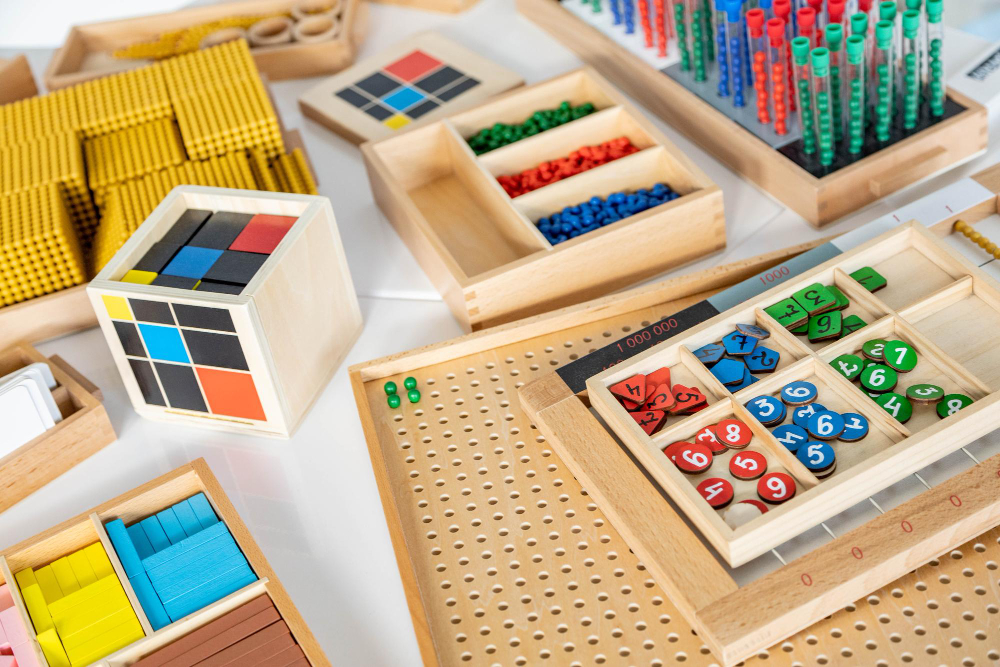
To deepen facilitation skills in short practical modules, consider the ChildCareEd course The Montessori Classroom: Theory to Practice Buy Now $25.00, which focuses on demonstration techniques and preparing effective materials.
Further Training Opportunities
For educators seeking to deepen their understanding of Montessori methods, ChildCareEd offers targeted courses that translate Montessori theory into classroom practice. Consider Montessori Foundations Buy Now $10.00 for a thorough grounding in the five learning areas and Montessori Assistant Training Buy Now $250.00$230.00 for practical strategies assistants can use to support independence, communication, and safety in the classroom.
Educators can also access valuable materials to enhance their teaching practices. ChildCareEd provides a selection of free resources, such as the Spot and Dot Letter A Activity Buy Now $0.00, which supports letter recognition and fine motor development. For curriculum ideas and adaptations, see our articles Tiny Tots, Big Learning and Unlock the Power of Montessori.
Which additional resources support hands-on learning in Montessori settings?
Educators can also access valuable materials to enhance their teaching practices. ChildCareEd provides a plethora of #free resources, such as the Spot and Dot Letter A Activity Buy Now $0.00, which aids in letter recognition and fine motor skills development. For curriculum ideas and adaptations, see our articles Tiny Tots, Big Learning and Understanding Montessori Materials.
How can educators stay current with Montessori practice and research?
To remain updated on the latest in Montessori education, read and subscribe to practitioner-focused articles such as What is Montessori? and The Montessori Classroom: A World Designed for Discovery. Regular reading, peer observation, and targeted courses support reflective improvements to practice.
How can educators engage with professional communities to strengthen practice?
Connecting with fellow educators and staying inspired is crucial. Following platforms like ChildCareEd on Instagram provides regular updates, tips, and community stories that enrich the teaching experience. Consider joining local study groups, virtual peer observation sessions, or mentoring networks; these formats support reflective practice and sustained implementation.
For classroom-level coaching and observation strategies, review How Earning the CDA Credential Can Help Educators in Observing and Assessing Young Children and use those notes to inform targeted training choices.
What are the key takeaways for applying hands-on Montessori methods?
Apply hands-on Montessori methods by preparing a predictable, scaled environment; offering a curated set of purposeful materials; and using brief, precise demonstrations followed by sustained observation. Prioritize children's agency by limiting adult prompting, using visual cues to scaffold independence, and rotating a small number of meaningful materials to maintain concentration and support skill transfer. Adapt materials for accessibility, document progress with competency-based observation notes and dated work samples, and use short videos or samples for reflective coaching with families. Start with a small, feasible plan (for example: set up two sensorial trays, schedule two three-part lessons weekly, and keep a running observation log) and use those notes to plan group lessons. Continue professional learning through targeted courses, peer observation, and mentoring to refine facilitation and sustain learner independence.
How can educators summarize and start applying hands-on Montessori methods?
Begin with a compact, measurable plan: set up two sensorial trays, schedule two three-part lessons each week, and keep brief observation notes tied to materials. Prioritize accessibility (scaled tools, tactile alternatives) and child agency, document dated work samples for coaching conversations, and rotate a small number of meaningful materials. Reflect weekly on observations and scale up gradually — small, consistent steps translate Montessori principles into daily classroom routines.
- Applying Montessori Principles at Home: A Guide for Parents
- The Importance of Hands-On Learning in Montessori Education
- Is Montessori Really for All?
- Understanding Intrinsic Motivation in Montessori Education
- The Absorbent Mind in Montessori Education
- Intrinsic Motivation in Montessori Education
- Focus on Nature and Real-World Experiences in Montessori Education
- The Purpose of Practical Life in Montessori Education
- Understanding Normalization in Montessori Education
- Montessori Theory in Practice: Bringing Child-Centered Learning to Life
- The Montessori Classroom: Fostering Independence and a Love for Learning
- Understanding Peer Learning in Montessori Education
- Montessori for Adolescents: The Erdkinder Program
- Unlocking Your Path to Montessori: The Ultimate Guide to Becoming an Educator
- Understanding the Basis and Benefits of Montessori Education
- Montessori & You: A Perfect Match?
- Montessori for Infants: Nurturing Independence from the Start
