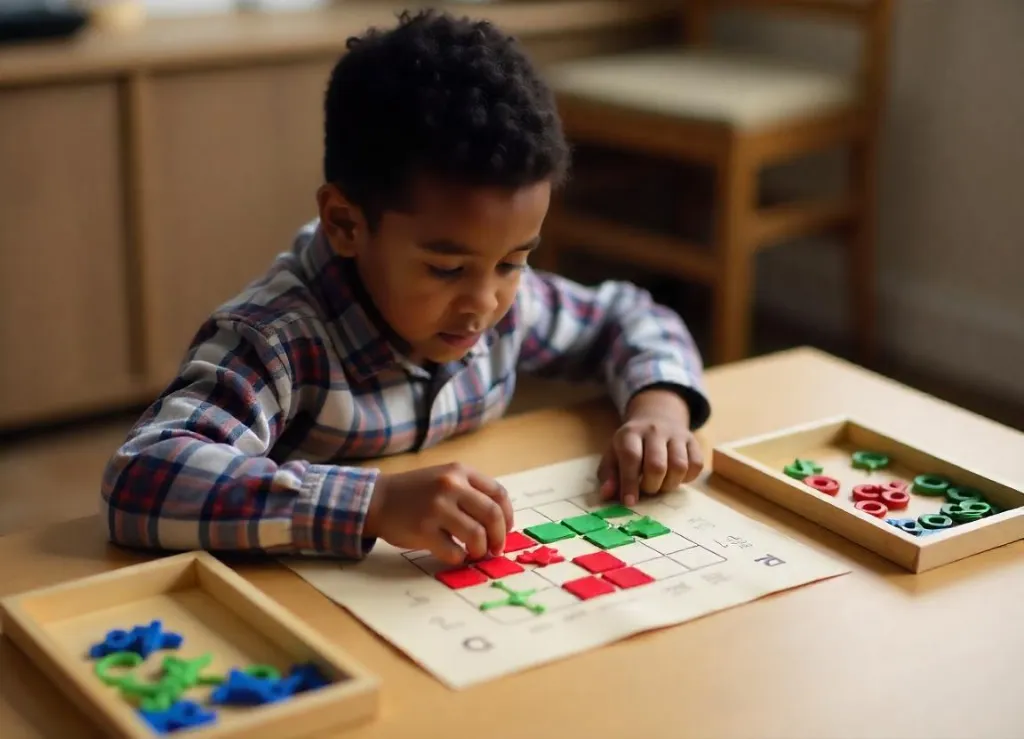
 Do you ever wonder why children with Montessori training sometimes play so quietly — and so deeply? There’s a kind of magic in their silence: focused concentration, self-driven exploration, and joyful engagement. Quiet play is not about being “well-behaved” or holding still — it’s about a child diving into their own inner world, becoming absorbed, and creating their own learning.
In Montessori philosophy, this capacity for deep focus is called concentration. It’s one of the greatest gifts we can support in children. When a child is fully absorbed in an activity, all kinds of growth is happening — brain, attention span, creativity, self-esteem, and more.
🧩 From Concrete to Abstract: The Montessori Approach to Learning
Montessori’s method emphasizes moving from concrete (hands-on) experiences to abstract (symbolic) understanding. The article Concrete to Abstract: The Montessori Approach to Learning explains this beautifully.
When a child works with real objects — bead chains, blocks, sandpaper letters — they make sensory connections. Over time, those connections internalize, and eventually they can think abstractly (e.g. doing math problems in their mind).
Quiet play is the fertile ground where that transition happens. A child might line up wooden beads, trace letter cards, or quietly fold cloths. In these calm moments, they’re turning concrete experience into internal logic.
One classic Montessori math tool is the bead chain. If you take a look at Counting & Skip Counting with Bead Chains, you’ll see how children use actual beads (in sets like tens and units) to learn counting, multiplication, and skip counting. Because they handle the beads, feel the weight, see the pattern, they build a strong, concrete foundation before moving toward mental math. For a broader look at Montessori math strategies that intentionally guide children from hands-on materials to mental computation, see Montessori Math: Preparing Children for Abstract Thinking and Cognitive Development.
🌱 The Power of Quiet Play
Why do Montessori children so often gravitate toward quiet, concentrated play? Here are some compelling reasons:
-
Freedom within limits. They choose their own materials, at their own pace, within a prepared environment.
-
Intrinsic motivation. There’s no external reward or praise. The interest itself is the reward.
-
Order and consistency. An environment that’s organized and predictable helps the mind settle, not jump around.
-
Repetition and mastery. In quiet time, children return to the same activity again and again, refining their understanding.
-
No interruptions. Adults allow them uninterrupted spans of time — often 20, 30, or 60 minutes — to pursue their interest.
When children are allowed to focus undisturbed, they develop concentration — and they begin to enter what Maria Montessori called “the absorbent mind”.
🧠 Montessori in the Digital Age: Where AI Meets Training
In our modern era, tools like AI language models might seem far from Montessori’s child-centered, tactile world. Yet there’s a bridge: the training and support of Montessori educators themselves.
If you're a trainer or educator, you might find this course interesting: Using AI Language Models for Trainers  Buy Now $16.00. It explores how AI can help design training materials, lesson plans, or support documentation — freeing up your time to focus more on observation and relationship with children.
To deepen your philosophical grounding, there’s also a foundational course: Understanding Maria Montessori’s Approach to Child Development Buy Now $55.00. It helps you internalize Montessori’s core insights about sensitive periods, normalization, and development.
With these tools, Montessori trainers and educators can better support quiet play in classrooms, and help parents see its value.
🛠️ For Parents: Cultivating Quiet Play at Home
Want to nurture that deep concentration at home? Here are some practical tips:
-
Simplify the environment. Fewer toys, clearly organized, with easy access.
-
Offer open-ended materials. Think puzzles, beads, blocks, or sorting trays.
-
Observe and resist intervening. Let your child lead; only offer help when asked.
-
Set aside uninterrupted time. Even 20 minutes a day of silent play can build a habit.
-
Respect the “work.” Even if things look messy, the child is learning.
When your child is quietly sorting stones or building a tower, that silence is rich with learning.
Quiet play in Montessori is not about silence for its own sake — it’s dynamic, internal, and deeply alive. Through concentrated play, children absorb their environment, turn concrete into abstract understanding, and build inner order and joy. Whether in a classroom or your living room, supporting that silence is one of the most powerful gifts you can give.
Don’t forget to follow ChildCareED on social media (Facebook, Instagram, LinkedIn) for more insights, tips, course updates, and #free resources to support your #early-childhood journey.
- Unlock the Power of Montessori
- Applying Montessori Principles at Home: A Guide for Parents
- The Benefits of the Montessori Method in Early Childhood Education
- Understanding Intrinsic Motivation in Montessori Education
- The Montessori Work Cycle: Fostering Independence and Focus
- Intrinsic Motivation in Montessori Education
- Control of Movement: Enhancing Motor Coordination and Concentration
- Understanding Normalization in Montessori Education
- The Montessori Classroom: Fostering Independence and a Love for Learning
- Understanding Sensitive Periods in Montessori Education
- Motivation’s vital role in how children engage with learning
- Shelf Work in Montessori Education: Encouraging Independence and Learning
- The Transformative Power of Montessori
- Montessori Magic: Why Parents Choose It & How Your Program Can Shine
- Montessori at Home: Chores That Empower
- Montessori Magic: Bringing Practical Life Skills to Life Through Play
